

Why most logistics operations break when volume doubles
Building processes is important to any business, but what many businesses fail to realise is how processes need to remain agile and dynamic. Workflows and processes are easy and quick to build with low volumes. Most processes put together can easily manage 300-500 parcels per day and look organised, manageable and efficient.
Many logistics operations look efficient at 300-500 parcels a day. Thousands seem easy to do because it’s all the same, right? The real test begins when that number becomes 5,000.
The thing about operations is that inefficiencies have a way of hiding when the volumes are low. They’re like sneaky illnesses that lie dormant and remain asymptomatic at the start. Often, they rear their ugly behinds later and become real problems down the road.
Why small operations can survive bad processes
When you have volumes that are low, logistics operations tend to be able to look efficient and manageable because a lot of the issues that come up, can be fixed just with a little bit of effort. What do I mean by this?
Let’s say, we build a process where we would have to send to our logistics partner a parcel manifest every day so that they know what they’re picking up. Maybe it’s not in the same format that Shopify exports it, so the team internally manually adjusts the export to match the partner’s format. Maybe the file is manageable for now, but what happens when that file grows bigger from 500 lines to 5,000 or 20,000? Will it still be manageable?
Another example is if there’s an exception or additional requirement. Say you ship globally and when you send parcels to Latin America, you need to export invoices for customs declaration, in some cases, you need to input VAT numbers in the invoices. Say that amounts to 10% of your business, that’s 50 manual processes that need to be done daily. Can it be done? Sure. Now scale that to 5,000. Can you do that for 500 parcels a day? Maybe, but how many people will you need to run that process?
People compensate for broken processes through experience and memory, and with small volumes with a small team, this is easily patched and manageable. Informal communications allow for quick responses, but lacks the structure required to ensure everything is accounted for. Many people might not even see this as a bottleneck at first, and workload wouldn’t be heavy enough for it to be an issue. Lower volumes always hide operational flaws with human effort. Call it brute force if you will.
What changes when volume doubles?
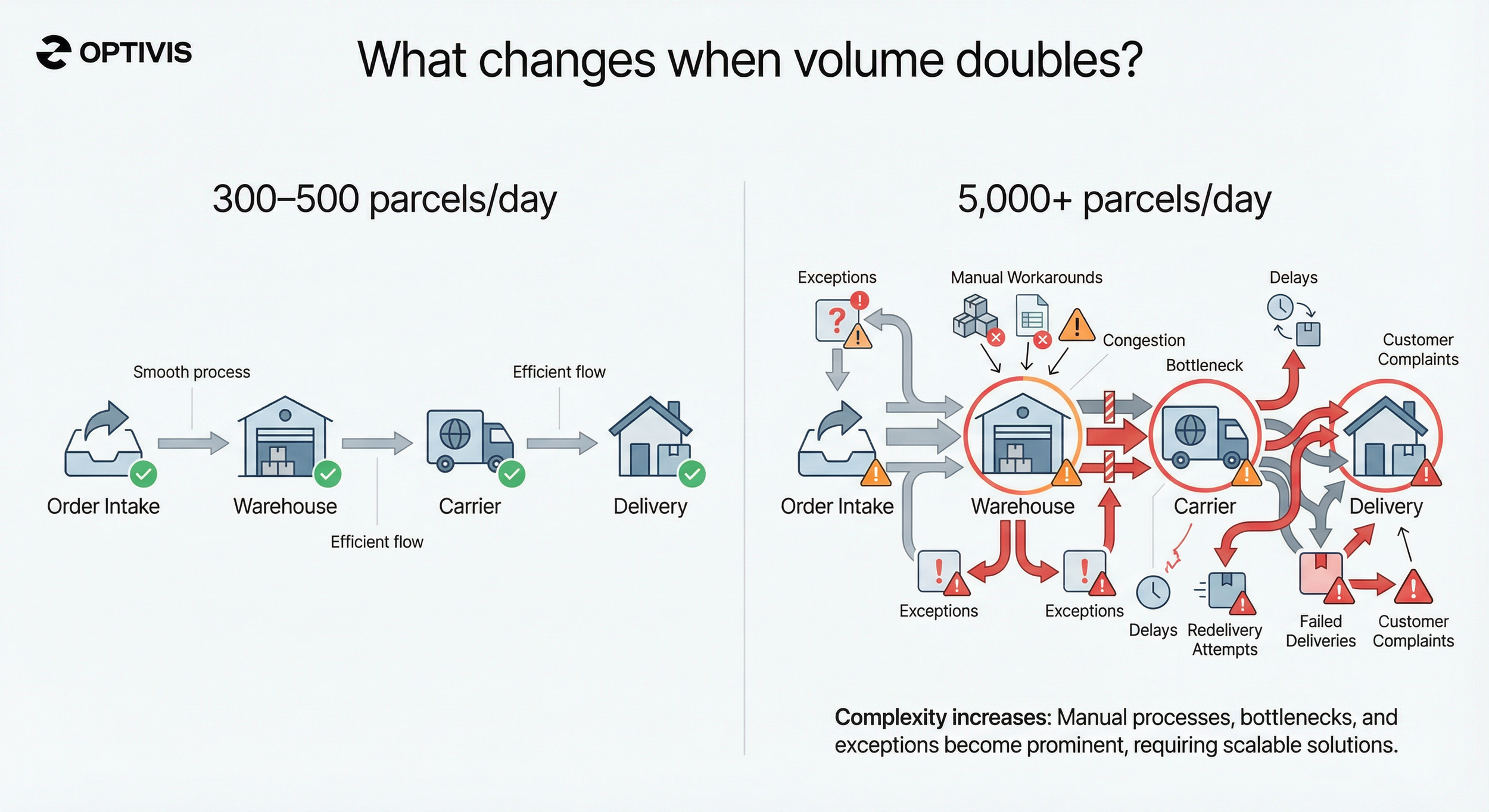
When volume starts to see real growth, you’ll see that the problems that stem from bad or rigid processes doesn’t grow in a linear way. It grows exponentially and disproportionate to the growth in volumes.
Suddenly, you’ll see that exceptions will become more common place. The interactions amongst teams will start to grow. You’ll see that the volumes will start to grow faster than you can communicate with each other. Coordination all of a sudden becomes more complex, errors with warehouse pickings increase, you’ll maybe even start to see data inconsistencies as the need for information grows across the different processes.
As logistics operations scale, you’re not just handling more shipments. You’re handling more decisions, more exceptions, and more coordination across teams.
Suddenly, a quirky import requirement stops becoming quirky and becomes a really blocker to growth.
The five early warning signs of operational failure
You can almost always tell when a system or processes are overloaded and is on its way to collapse. There will always be signs that you can look out for and prepare yourself to change processes and improve workflows.
1. Increasing reliance on manual workarounds
This is almost always the number 1 sign that a process is broken when scaling. When you have your teams constantly fixing system errors manually or doing manual work. When Excel sheets starts replacing system workflows. When teams create side processes to keep the operations moving.
All of these are signs that your team is patching a hole on the ship that’s starting to sink. Sure, maybe the patch will hold for a while, it might even be highly effective. However, you don’t sail a ship with holes patched up at sea into a raging storm expecting it to survive, do you?
2. Growing operational bottlenecks
This is very visible and apparent. When a particular role becomes overwhelmed with workload. Maybe you have exceptions or side processes that are manual that require active human intervention. Like providing invoices can be easy if it’s sub 100. But when you have hundreds if not thousands to do? That becomes overwhelming very quickly.
Queues of tasks or work will start forming in specific parts of the operation that will lead to bottlenecks. You’ll see that maybe the process requires manual adjustments or approval, and then it gets stuck because the work cannot be done fast enough.
3. Rising exception rates
You’ll start to see more delayed shipments. More incorrect routing or sorting errors, maybe even labelling mistakes. You’ll also start seeing escalations becoming more commonplace.
4. Information fragmentation
This is where you’ll realise there’s a real problem. Teams will start relying on different versions of data and you’ll struggle to keep one source of truth. Systems don’t sync properly and you’ll start to struggle to trust the data and have problems getting on the same page.
5. Management firefighting
The management team will also start to see more operational escalations that require special attention. Your management team will spend more time solving urgent operational issues and less time strategising and planning.
When the management team starts being reactive instead of proactive, that’s when you know your operations is under stress.
Why throwing more people at the problem doesn’t work
Okay, okay. We’ve all been there. We see a problem, we throw money at said problem. In instances like this, it’s people. In most cases, it works. In this one, not so much.
We see it all too often, volume starts to grow, and suddenly companies are justifying a growth in staff, extending working hours, adding more supervisors to work round the clock.
The problem here is, the more people there is, the more coordination you need, which increases overall complexity. You’re brute forcing a fix while increasing your probability to more issues. You’re opening yourself up to more problems because you’re not fixing the problem, you’re patching a hole that’s just getting bigger. Poor processes scale with the business, it scales into larger chaos for people to firefight.
Eventually, you’ll realise that your labour cost has increased but your operational efficiency and reliability either stays stagnant or becomes worse.
What scalable logistics operations do differently
To understand what scalable logistics operations do differently, you first need to understand what scalability actually means.
Scalable operations aren’t just processes that work today. They’re processes that are designed to continue working when the volume grows, when exceptions increase, and when the operation becomes more complex.
Most small logistics operations rely heavily on quick fixes. Someone builds a workflow to solve today’s problem, another person patches a gap somewhere else, and over time the entire operation becomes a collection of workarounds held together by human effort.
That might work at 300 or 500 parcels a day. It stops working when the operation grows.
Scalable logistics operations take a very different approach. Instead of building processes that depend on people remembering things or manually fixing issues, they build workflows that remove ambiguity as much as possible.
That means fewer manual interventions, fewer side processes, and fewer moments where someone needs to stop and ask, “What do we do in this situation?”
Good scalable operations also design their workflows around flow and bottlenecks, not just capacity. It’s not about how many parcels you can process in theory. It’s about whether the operation can continue moving smoothly when volumes increase, when exceptions appear, and when different teams need to coordinate.
Exception handling is another area where scalable operations differ. Instead of treating exceptions as ad-hoc problems that someone needs to fix manually, strong operations design structured processes for handling them. Exceptions are expected, planned for, and managed within the workflow.
Finally, scalable logistics operations prioritise visibility and reliable data. When teams trust the data and everyone works from the same source of truth, coordination becomes significantly easier and decisions become faster.
In simple terms, scalable logistics operations aren’t built on improvisation. They’re designed deliberately, with growth in mind, so that the operation continues to function even when the volume doubles.
The real test of logistics operations
The real test of a logistics operation isn’t how well it performs when volumes are comfortable. Almost any operation can look efficient when the shipment count is low and the team still has the capacity to manually intervene when something goes wrong.
The real test comes when the volume starts to grow.
When shipments double or triple, the cracks in an operation begin to show. Processes that once felt manageable suddenly become bottlenecks. Manual workarounds stop being small inconveniences and start becoming daily operational burdens. What once took a few minutes of adjustment now requires entire teams just to keep things moving.
This is the moment where many companies realise that their operation was never truly scalable. It was simply surviving on human effort.
Strong logistics operations are different. They are designed with growth in mind from the very beginning. Their workflows are structured, their exception handling is deliberate, and their systems are built to maintain clarity even when the complexity of the operation increases.
The companies that scale successfully are not the ones that react to operational chaos as it appears. They are the ones that take the time to step back, examine how their operations actually function, and rebuild processes in a way that can support the next stage of growth.
This is often the hardest part of scaling logistics. When you’re in the middle of daily operations, it’s difficult to see where the real bottlenecks are or which parts of the process will break first as volume increases.
But one thing is almost always true.
If an operation requires constant manual intervention to function today, it will almost certainly struggle tomorrow when the volume doubles.
The earlier these structural weaknesses are identified and addressed, the easier it becomes to build an operation that can grow without collapsing under its own complexity. At Optivis, this is often where we see the biggest opportunity for transformation, not in adding more technology or manpower, but in redesigning the underlying processes so the operation can scale with confidence.